How Does Monetary Policy Affect Inflation
This subsection outlines how the CBA implements monetary policy to achieve its price stability objective. It explains the channels through which changes in policy rates affect aggregate demand and inflation.
The CBA implements monetary policy to achieve and maintain its price stability objective (What is price stability?). At the CBA, we define price stability as an annual inflation target of 3%. Of course, this does not mean that at every given point in time, inflation must be exactly 3%; inflation can be lower or higher than 3% on a period-by-period basis. Overall, the public must be assured by the actions of the Central Bank that it will converge to 3% on average over the medium term.
We use various tools to implement monetary policy in order to achieve our mandate (Monetary Policy Tools and Instruments). Our main monetary policy tool is the refinancing rate. By raising or lowering the refinancing rate, we aim to affect the behavior of economic agents in order to anchor medium- and long-term inflation expectations at the 3% target. In general, changes in policy rates can affect other interest rates in our economy, which, in turn, affect the behavior and decisions of economic agents (e.g. households, businesses, etc.). This is reflected in aggregate demand and inflation developments. The decision to adjust CBA’s monetary policy tools is based on a comprehensive analysis of the current state of the economy and its driving forces, while being mindful of the different types of policy-relevant risks and areas of uncertainty.
Monetary policy decisions (How do we make monetary policy decisions?) affect the behavior and decisions of economic agents through different channels, ultimately impacting aggregate demand and inflation. It is important to emphasize that changes in policy rates are transmitted throughout the economy gradually, and it takes time before monetary policy has its full effect on the economy and on inflation.
Monetary policy transmission mechanism
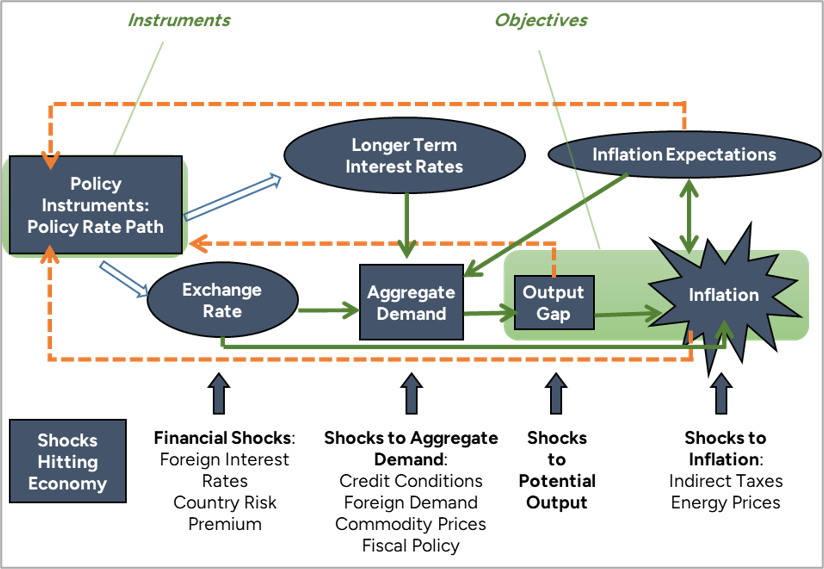
The monetary policy transmission mechanism, or the channels through which changes in policy rates affect aggregate demand and inflation, is a complex phenomenon. In simple terms, monetary policy is transmitted through the economy in the following way:
- Changes in the Central Bank’s refinancing rate affect short-term interest rates, which transmit into the behavior of other interest rates in the economy. As interest rates throughout the economy adjust, this impacts the consumption and investment behavior of economic agents, which is reflected in aggregate demand and inflation.
- Changes in policy rates also work trough the exchange rate channel. When a central bank increases its policy rates, it tends to attract foreign capital inflows, leading to an appreciation of domestic currency. The appreciation of the local currency can result in lower export competitiveness, cheaper imports, and, as a result, reduced economic growth and inflation.
- The success of monetary policy is heavily dependent on the inflation expectations of economic agents. Inflation expectations play a vital role in shaping economic behavior and decisions. When economic agents expect high inflation in the future, they may adjust their present spending and choose to invest less. This can create a cycle where consumer spending accelerates and makes inflation rise even more. Further, inflation expectations directly influence the effectiveness of monetary policy measures. If inflation expectations are well anchored to the central bank’s inflation target, it becomes easier for the central bank to manage inflation through interest rate adjustments and other policy tools.
- The monetary policy stance (i.e. how high or low the policy rate is) also affects asset prices, banks’ lending conditions, firms’ balance sheet positions, and so on.
Key Features of Monetary Policy Transmission Mechanism