Framework and Institutional Setup
Recognizing the increasingly complex layering of challenges and uncertainty facing monetary policy, beginning in 2021 the Central Bank of Armenia initiated a comprehensive process to fundamentally reimagine its existing approach to monetary policy. With the goal of introducing a best-in-class monetary policymaking framework that allows to achieve its price stability mandate in a more effective, credible, transparent, and accountable manner the CBA worked with leading international experts to develop a novel, prudent risk management approach to monetary policy, known as FPAS Mark II. The framework represents a holistic policymaking and institutional setup that evolves several aspects of the original FPAS Mark I, by placing increased emphasis on uncertainties and risk management in monetary policymaking. The vision for developing FPAS Mark II stems from the 2021 CBA Strategy, which outlined the need to have among the best policymaking frameworks in the world.
In parallel to the new FPAS Mark II framework, the CBA has emphasized the importance of a strong institutional setup to support its implementation. This includes the continuous development of human capital, ensuring a highly skilled, mission-driven staff capable of conducting robust economic analysis and supporting decision-making processes. The Central Bank has redefined the roles and responsibilities between its Board and Staff to foster greater collaboration, with the Board focusing on setting policy and the Staff providing continuous analysis and assisting with the preparation of policy reports.
Monetary Policy Framework
FPAS Mark II framework builds on the existing FPAS framework by placing increased emphasis on uncertainties in monetary policymaking. It introduces a structured and systematic approach to thinking of monetary policy as a risk management exercise along with a framework for implementing policies of “least regrets”
FPAS Mark II represents the next generation of the Forecasting and Policy Analysis System (FPAS), which was first developed at the Reserve Bank of New Zealand and the Bank of Canada. The FPAS represents a systematic, structured and forward-looking approach to policymaking that fully embodies the fundamental principles of inflation targeting.
FPAS Mark II framework builds on the existing FPAS framework by placing increased emphasis on uncertainties in monetary policymaking. It introduces a structured and systematic approach to thinking of monetary policy as a risk management exercise along with a framework for implementing policies of “least regrets”. The explicit acknowledgement of uncertainties in the policymaking process, coupled with a fundamental shift in the perception of monetary policymaking as an exercise in “expert forecasting” to one of “risk management,” are among the key foundations of the new framework.
Under FPAS Mark II, the macroeconomic narrative is constructed around case scenarios (Case A, Case B scenarios), which are illustrative in nature and are designed to explicitly describe and address risk and uncertainty. These illustrative case scenarios are built to reflect on the following essential questions: Where is the economy now? What are the driving forces? What policy actions need to be done to reach policy objectives? This scenario-based approach is intended to provide much more flexibility and agility to respond to new information and continuous improvements in assessments of economic conditions and drivers.
Under the FPAS Mark II framework we develop and analyze two or more illustrative scenarios that would imply a higher or lower path for interest rates than is currently priced in financial markets. Market Reference is the expected path of the policy rate that is currently priced in financial markets. Case A reflects a scenario that incorporates economic and financial developments that would require a higher interest rate path than what is currently priced in financial markets. Case B reflects a scenario that incorporates economic and financial developments that would require a lower interest rate path than what is currently priced in financial markets.
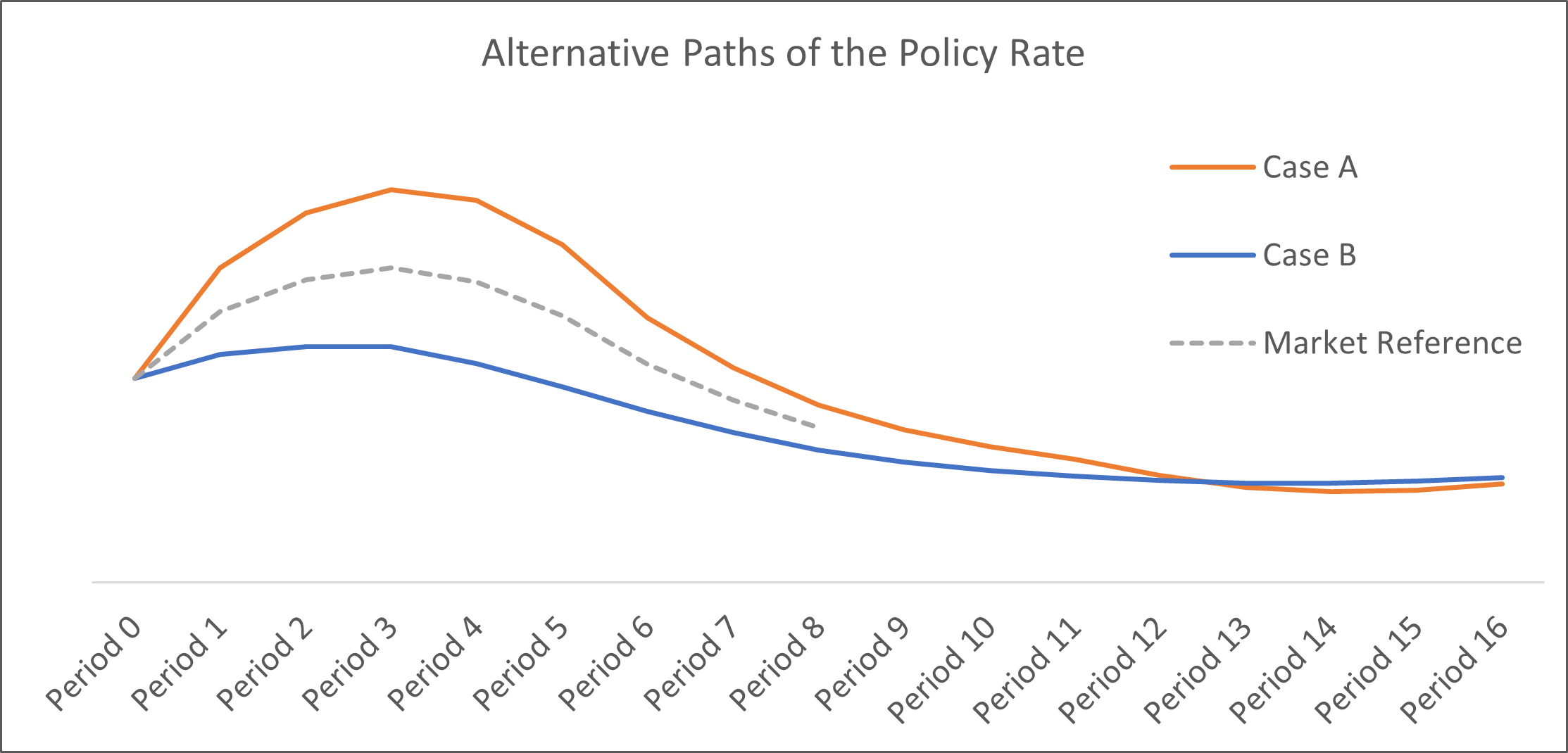
Note: For Illustrative Purposes Only
FPAS Mark II: The Next Generation of FPAS
Of course, a comprehensive, holistic policymaking framework goes well beyond how scenarios are structured. FPAS Mark II entails the following evolution and key changes to the existing framework:
- Robust Analytical Framework & Suite of Models: best-in-class analytical models, including the quarterly projection model incorporating crucial nonlinearities such as endogenous policy credibility, are an important foundation of a good policymaking framework. We continue to emphasize the role of models as tools that help policymakers and economists think better.
- Investments in Human Capital: Effective monetary policymaking requires making significant investments in staff, including comprehensive training within a dynamic learning environment, developing a culture of continuous feedback-sharing, eliminating unproductive hierarchies, among others
- High Degree of Transparency & Accountability: As a socially responsible public institution, we strongly advocate for transparency and accountability as foundational and guiding principles. We firmly believe that clear and effective communications are the principal means through which the central bank can achieve transparency in its policymaking. Moreover, transparency serves as a cornerstone for central bank accountability. Together, transparency and accountability serve as important means for assuring general public’s confidence and trust in CBA’s monetary policymaking process, and incentivizing the institution’s staff and leadership to do the right thing (learn more about Monetary Policy Transparency).
Society-Level Capacity Building: FPAS Mark II emphasizes the importance of improving financial and economic literacy at all levels of society—from primary education to media to financial markets.
Institutional Setup
A strong and well-defined institutional framework is key to ensuring coherent decision-making, promoting transparency, and supporting effective policy implementation
Human Capital: The Central Bank of Armenia prioritizes human capital development, focusing on building a highly skilled, mission-driven staff to support robust economic analysis, informed decision-making, and the implementation of overall strategic objectives of the institution. With the introduction of best-in-class approaches to monetary policy decision-making in FPAS Mark II, we have rethought the role human capital ought to play in this revitalized system. Under FPAS Mark II, the development of human capital is a fundamental priority of the CBA. Our human capital framework is built on the core principle that the near- and long-term growth and wellbeing of a well-trained and mission-driven staff is the cornerstone of good economic analysis and policymaking. The vision for having a human-capital-first organizational approach is to develop a truly world-class organizational culture among the staff: high and rapidly-growing productivity; efficient processes and resource-allocation that minimize bureaucratic hierarchies; a collegiate culture of collaboration that incentivizes staff to learn and grow; greater dynamism and flexibility in how teams are formed and how staff allocate their time; and, most importantly, a clear sense of purpose and social mission among the staff.
Distinguishing between Board and Staff Roles and Responsibilities: The Board is responsible for setting monetary policy through the policy rate and other instruments. This requires taking a stance on current and underlying economic developments, and transparently communicating to the public how this view supports the policy decision. The Staff is responsible for conducting current analysis; regularly briefing the Board on economic developments; preparing illustrative scenarios during each projection round; preparing the Monetary Policy Report; and assisting the Board in other policy-related matters.
Exchange Rate Policy: The CBA’s foreign exchange policy is aimed at enhancing the reliability and international credibility of the Armenian Dram and creating a legal and economic framework for current account operations, capital account and foreign investment flows, through an effective management of currency reserves of the Republic of Armenia.
Since July 1996, the CBA has adopted a freely floating exchange rate regime, which is enshrined in law and supported by the principles of the foreign currency operations framework. The CBA is implementing a freely floating exchange rate regime, which means that we do not maintain a specific level for Armenian Dram (AMD) relative to other currencies, and the level of exchange rates are determined purely by market forces (i.e. supply and demand dynamics of AMD, relative to other currencies in the world). Importantly, the freely floating exchange rate regime is consistent with the principles of liberalized capital account operations and implementation of an independent monetary policy. The CBA publishes the Armenian Dram's market based average exchange rates vis-à-vis foreign currency.
There are some rare circumstances, however, where it may be necessary for the CBA to intervene in the AMD foreign exchange market. The CBA only intervenes in exceptional circumstances when the exchange rate is exceptionally high or low and is not justified by economic fundamentals. In such cases, the CBA’s intervention in the foreign exchange market must be entirely consistent with our monetary policy and financial stability objectives, and is only implemented if market conditions are appropriate and would have a reasonable chance of success.