| In the aftermath of the October revolution in 1917 Armenia, Georgia and Azerbaijan left the Russian Empire soon to create the Transcaucasian Commissariat, an independent constituency. In February of 1918, the Transcaucasian Commissariat issued 1, 3, 5, 10, 50, 100 and 250 ruble denominated banknotes. For the first time Armenian inscriptions appear on these banknotes, and the Armenian numismatic intelligence takes them as the first Armenian paper notes. |
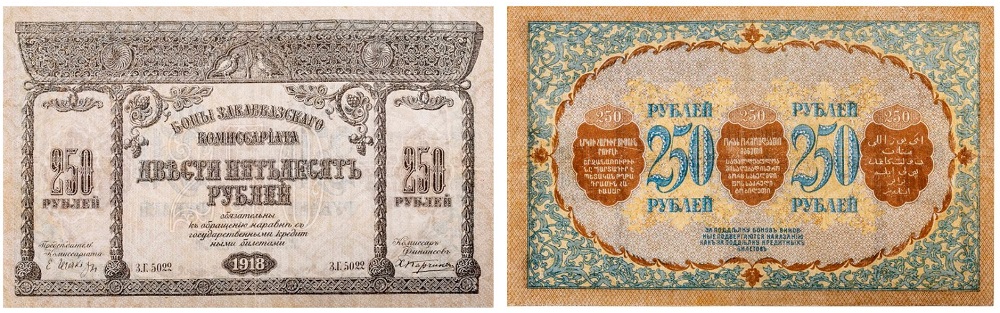 |
| Pic. Transcaucasian Commissariat, banknote of 250 ruble denomination. |
| Achieving independence on May 28, 1918, the first Republic of Armenia put the checks, as issued by Yerevan branch of the State Bank, into circulation, and then, the banknotes of 50, 100 and 250 ruble denomination. Those were designed by H. Kojoyan and A. Fetvadjian and printed by “Waterloo & Sons Limited” in London. This issue stands out for its decoration using traditional style in painting and ornaments. |
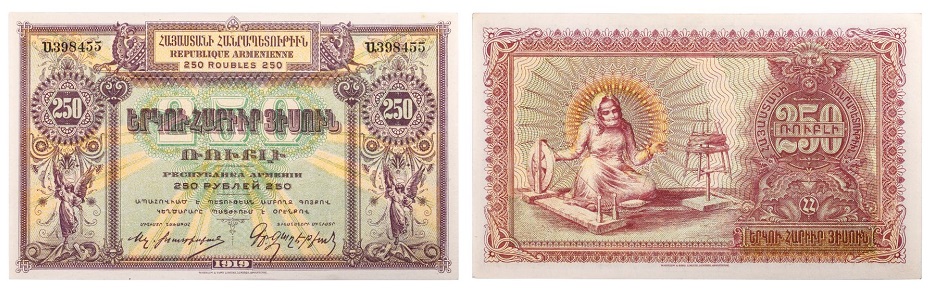 |
| Pic. The First Republic of Armenia, banknote of 250 ruble denomination. |
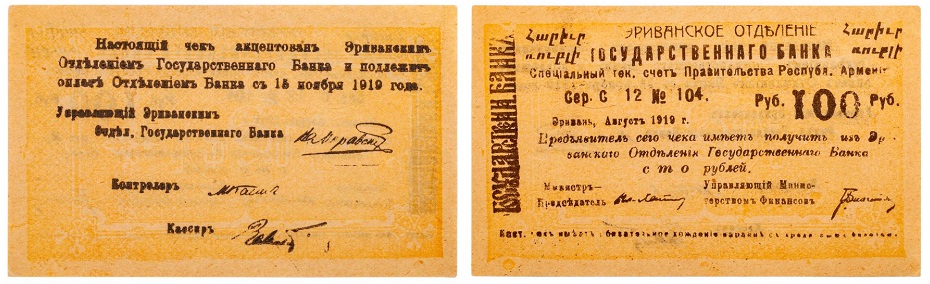 |
| Pic. The First Republic of Armenia, check of Yerevan Branch of the State Bank. |
| On 2 December 1920 the Republic of Armenia was announced the Soviet Socialist Republic, and on 20 December the authorities of the Soviet Armenia enacted a decree stipulating mandatory circulation of banknotes of the Soviet Russia. However, the decree did not contravene issuance of local currency. |
| In 1921, the banknotes of 5000 and 10000 ruble denomination came in. |
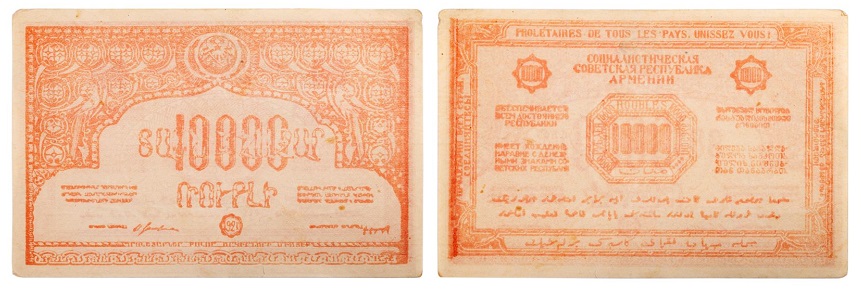 |
| Pic. Armenian SSR, banknote of 10000 ruble denomination. |
| In 1922 the banknotes of 25000, 100000, 1 million and 5 million ruble denomination as well as a bill at par value of 5 million ruble were issued. |
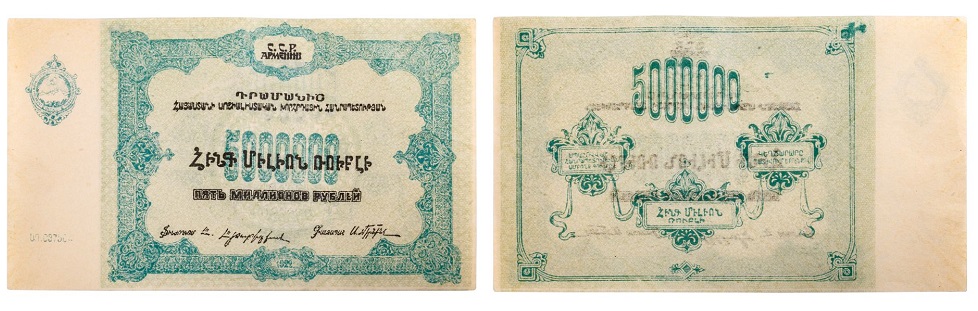 |
| Pic. Armenian SSR, banknote of 5 million ruble denomination. |
| In 1922, three republics – Armenia, Georgia and Azerbaijan – united to constitute the Federative Union of Transcaucasian Soviet Socialist Republics. The FUTSSR issued the banknotes dated 1923 of 1000, 5000, 10000, 25000, 50000, 100000, 250000, 500000, 1 million, 5 million and 10 million ruble denomination. |
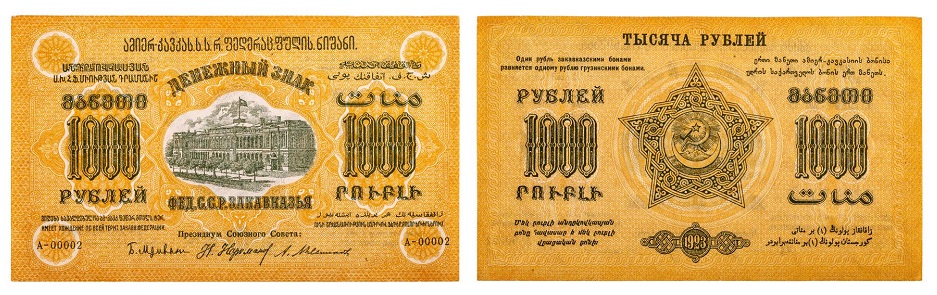 |
| Pic. FUTSSR, banknote of 1000 ruble denomination. |
| In 1922, three republics – Armenia, Georgia and Azerbaijan – united to constitute the Federative Union of Transcaucasian Soviet Socialist Republics. The FUTSSR issued the banknotes dated 1923 of 1000, 5000, 10000, 25000, 50000, 100000, 250000, 500000, 1 million, 5 million and 10 million ruble denomination. |
| At the end of 1922 the FUTSSR was transformed into Transcaucasian Socialist Federative Soviet Republic (TSFSR) which issued the banknotes dated 1924. In 1924 TSFSR issued 25, 50, 75, 100, 250 million and 1 and 10 billion ruble denominated banknotes. Albeit designed and prepared, the banknote of 10 billion ruble denomination, as well as the bill dated 1923 at par value of 1 chervonets were never put into circulation. |
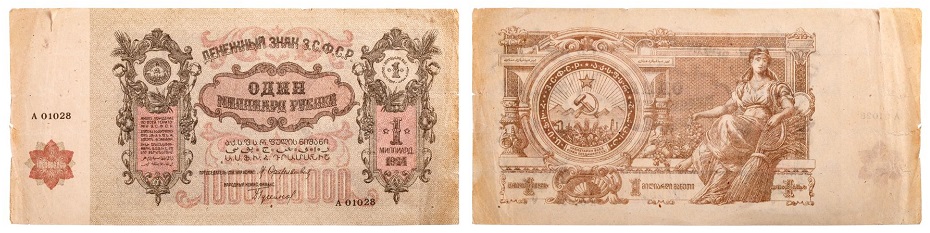 |
| Pic. TSFSR, banknote of 1 billion ruble denomination. |
| A monetary reform in 1924 replaced all types of banknotes in circulation in Transcaucasia for the banknotes of unified samples of the Soviet Union. |